
Written by the Cosmetic Dentistry Team at Aspenwood Dental Associates | Medically Reviewed by the Lead Clinician, Aspenwood Dental
Key Takeaways
- The “fake” veneer look is caused by flat, opaque porcelain and uniform shading — not by veneers as a category.
- Natural-looking results depend on three technical factors: translucency, micro-texture, and facial integration — all of which require a skilled ceramist, not just a dentist.
- You can — and should — approve the exact shape, shade, and feel of your veneers before the final porcelain is bonded, using a trial prototype.
- The Colorado aesthetic favors understated, realistic results over the high-gloss “Hollywood” look. That’s precisely what Aspenwood’s smile design process is built around.
Natural-looking veneers are achievable — but they require a specific combination of material science, ceramist artistry, and a design process that treats your face as the blueprint. The problem isn’t the veneers themselves. The problem is the outdated, one-size-fits-all approach that still dominates many practices. If you’ve ever hesitated because you’re afraid of ending up with teeth that look too white, too uniform, or too obvious, that fear is valid — and it’s exactly what this guide addresses.
Why Do Some Veneers Look Fake? (The “Uncanny Valley” Problem)
The “Turkey Teeth” phenomenon — that blocky, hyper-white, plastic-looking result — has a clinical explanation. It comes down to two failures: material opacity and monochromatic shading.
Standard, lower-cost veneers are often fabricated as a single, uniform block of porcelain with one consistent shade and a smooth, flat surface. Natural teeth don’t work that way. A real tooth has a gradient color (darker at the base, lighter and more translucent at the biting edge), surface micro-texture that scatters light in multiple directions, and subtle asymmetries that the human eye reads as alive.
When a veneer lacks all three of those properties, the brain registers it as wrong — even if the observer can’t articulate why. That’s the dental version of the uncanny valley: close enough to look like a tooth, but off enough to feel artificial.
The solution isn’t to avoid veneers. It’s to demand the right process.
What Actually Makes Veneers Look Natural in 2026?
The 2026 standard in high-quality cosmetic dentistry has moved decisively away from the “Hollywood White” aesthetic toward what’s best described as biomimetic realism — porcelain that behaves like enamel, not like ceramic tile.
Three technical properties define this standard.
The Light Test: How Real Enamel Reflects Light
Hold a natural tooth up to light, and it does something a cheap veneer won’t: it glows from within. This is because enamel is semi-translucent. Light enters, scatters through the internal structure, and exits at a slightly different angle. The result is a depth and luminosity that reads as healthy and alive.
Achieving this requires polychromatic layering — a hand-building technique where a master ceramist applies multiple layers of porcelain with varying degrees of opacity and translucency. The incisal (biting) edge is typically the most translucent zone, mimicking the natural wear pattern of real teeth. The body of the veneer carries the primary shade, and the base transitions to a slightly warmer, more opaque tone near the gum line.
This is not a standard workflow. It requires a skilled ceramist and a dentist who communicates precise optical goals — not just a shade number.
Micro-Texture Mapping: The Detail That Changes Everything
This is the element almost no competitor discusses, and it may be the single biggest factor separating a natural result from a plastic one.
Natural teeth have perikymata — tiny horizontal ridges that form during tooth development — and subtle vertical developmental grooves. These surface irregularities are what break up light reflection and prevent teeth from looking like polished bathroom tiles. When a veneer is fabricated with a perfectly smooth surface, it catches light uniformly, creating that telltale “shine” associated with obvious dental work.
At Aspenwood, the smile design process incorporates micro-texture mapping: the deliberate addition of surface anatomy — fine vertical grooves, slight surface variation, and controlled irregularities — to replicate the way natural teeth interact with light. The result is porcelain that doesn’t announce itself.
Does Material Choice Affect How Natural Veneers Look?
Significantly — and this is a conversation worth having explicitly with your dentist before any prep work begins.
Feldspathic porcelain (hand-layered) remains the gold standard for aesthetic cases where translucency is the priority. It most closely mimics the optical behavior of natural enamel and allows for the polychromatic layering described above. The trade-off is that it is more technique-sensitive and requires an experienced ceramist.
Lithium disilicate (e.max) is a pressed ceramic that offers excellent strength and good aesthetics. It can be fabricated using a “cut-back” technique — where the technician removes material from the incisal edge and layers translucent porcelain on top — to achieve a more natural light response than a fully monolithic restoration.
Zirconia, while exceptionally durable, is typically the least translucent of the three and is generally better suited for posterior (back) teeth or patients who prioritize strength over the finest aesthetic nuance.
For patients whose primary goal is an indistinguishable, natural result, feldspathic or cut-back e.max are typically the materials of choice. Your specific bite, tooth preparation requirements, and lifestyle will all factor into the final recommendation.
Can You Choose the Exact Shape and Shade of Your Veneers?
Yes — and if a practice isn’t offering you this level of input, that’s a red flag.
A rigorous smile design process begins with Digital Smile Design (DSD): a digital preview that maps your proposed veneer shape against your lip dynamics, facial proportions, and natural smile arc. This isn’t just a cosmetic exercise. It’s a functional blueprint that accounts for how your lips move when you speak, laugh, and smile at rest.
From there, a physical wax-up translates the digital plan into a three-dimensional model. This is then used to fabricate your trial smile — a set of temporary veneers that you actually wear. You can see how they look in Colorado sunlight, not just in a dental chair under clinical lighting. You can test how they feel when you speak. You can get a second opinion from people who know your face.
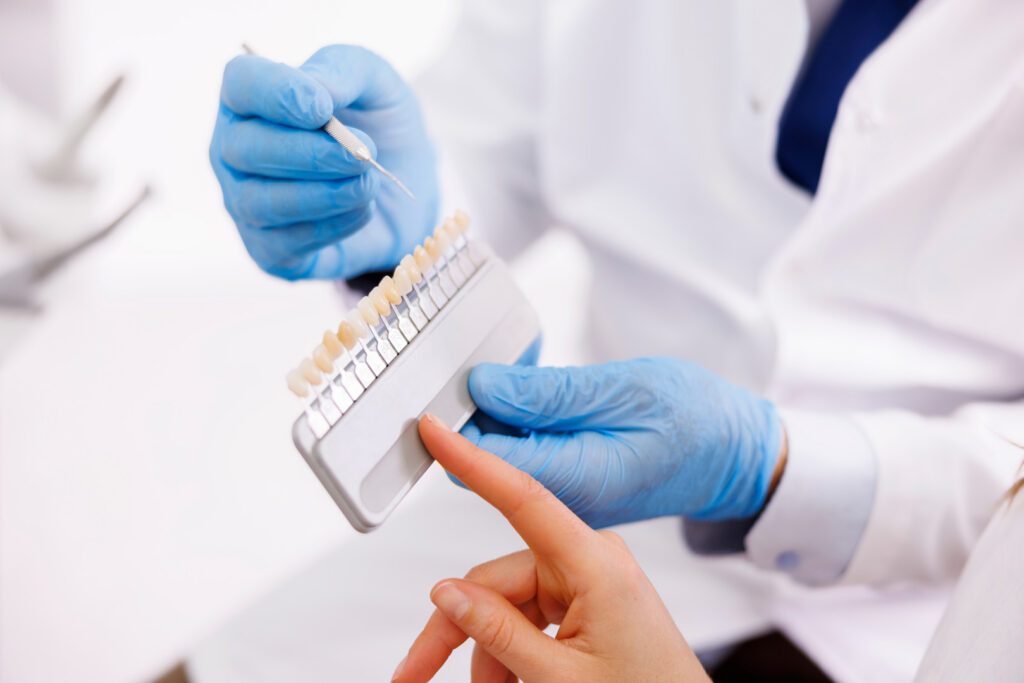
Shape libraries allow you to reference specific incisal edge profiles — from a softer, more rounded feminine form to a more squared, defined masculine shape. Shade selection goes beyond a single letter-number code; it involves mapping value (brightness), chroma (color saturation), and hue (the underlying color family) against your skin tone and eye color.
Subtle, intentional asymmetry is often part of the design conversation, too. Perfectly uniform teeth can paradoxically look more artificial than a smile with slight natural variation. Defining what “natural” means to you — including what imperfections you want to keep — is part of the process.
The “Social Test Drive”: Why the Trial Smile Is the Most Important Step
The temporary veneer phase is not a formality. It is your most important quality control checkpoint.
Aspenwood’s approach includes what we call a Social Test Drive protocol: patients wear their temporary prototypes for a full weekend before final approval. The goal is to evaluate the result in the real environments that matter — a dinner with friends in Aurora, a work presentation, a family gathering. Not a mirror in a dental office.
This matters because the way teeth look under clinical lighting and the way they look in natural Colorado daylight can differ meaningfully. It also matters because confidence is part of the outcome. If you feel self-conscious about your temporaries, that’s critical information — and it’s information you can act on before anything is permanently bonded.
According to the American Academy of Cosmetic Dentistry, patient communication and trial evaluation are among the most significant factors in long-term satisfaction with cosmetic dental work. The trial smile phase is where that communication becomes concrete.
Do Natural-Looking Veneers Cost More Than Standard Veneers?
Typically, yes — and the reason is transparent: hand-layered porcelain, a skilled master ceramist, and a multi-appointment design process require more time and expertise than a same-day or low-prep alternative.
What you’re paying for is the difference between a veneer fabricated to a shade code and a veneer designed to your face. The cost difference reflects the ceramist’s labor, the material quality, and the number of design iterations involved in getting the result right before anything is permanently placed.
That said, the more meaningful cost comparison is between getting it right the first time versus the cost — financial and emotional — of revision work. Veneers that need to be replaced or corrected because they look unnatural are a significantly more expensive outcome.
Aspenwood offers a complimentary consultation where we walk through your specific goals, the recommended materials, and a transparent cost breakdown — no pressure, no sales pitch. That conversation is the right starting point.
What To Do Next
You don’t have to guess what your result will look like before committing.
The Aspenwood smile design process — from your Digital Smile Design preview to your Social Test Drive weekend — is built specifically to eliminate that uncertainty. Our team has been serving Aurora and the Denver metro since 1972, and our approach to custom porcelain veneers has always prioritized one outcome above all: results that look like you, only better.
If you’d like to see what that looks like in practice, browse natural smile makeovers in our patient gallery or read more abouthow Dr. [Name]’s artistic training shapes every case.
When you’re ready to take the next step, schedule your complimentary digital smile preview — and let’s figure out exactly what your smile needs, together.
Aspenwood Dental Associates | 2900 S Peoria Street, Suite C, Aurora, CO 80014 | ⭐ 4.9 stars across 1,660+ Google reviews | 5280 Top Dentists, multiple years
 How to Overcome Dental Anxiety After a Bad Experience