
A Conservative, Long-Lasting Restoration That Puts Your Natural Tooth First
For Aurora and Denver families who want to preserve what they have — not just patch it and hope for the best.
If your dentist mentioned an inlay or onlay, or if you’re looking for a second opinion before committing to a full crown, you’re in the right place. At Aspenwood Dental Associates and Colorado Dental Implant Center, we’ve been helping families in Aurora navigate exactly these kinds of decisions since 1972. Our approach is simple: we take a big-picture mindset, walk you through every option clearly, and never recommend more treatment than your long-term oral health actually requires.
This page is part of our full range of cosmetic and restorative dentistry services — focused specifically on how custom inlays and onlays can save your natural tooth structure when a standard filling isn’t enough and a full crown isn’t yet necessary.
When a Filling Isn’t Enough — and a Crown Is More Than You Need
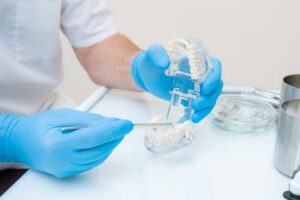
What are inlays and onlays? An inlay fits within the cusps of a tooth to restore a damaged or decayed area that’s too large for a standard filling. An onlay, sometimes called a “partial crown” extends over one or more cusps when the damage is more widespread but still doesn’t require capping the entire tooth.
For many Aurora patients, this distinction matters enormously. Colorado’s high-altitude climate and dry air contribute to a higher rate of tooth dehydration and micro-cracking, a pattern our team sees regularly in patients who’ve lived along the Front Range for decades. When a tooth develops a crack or large cavity from years of temperature cycling between frigid winters and intense summer sun, the damage often falls squarely in the territory where an onlay is the most conservative, structurally sound solution available.
Unlike a full crown, which requires grinding down a significant portion of healthy enamel, an inlay or onlay preserves the maximum amount of your natural tooth structure. That matters not just today but for the long-term stability of your jaw, bite, and neighboring teeth, the kind of big-picture thinking that defines how we practice dentistry here.
Our Aurora inlay and onlay services include:
- Inlay/Onlay Replacement for Failing Amalgam Fillings — upgrading older, large silver fillings that are cracking or leaking before they compromise the rest of the tooth
- Custom Porcelain Inlays for Aurora’s High-Altitude Dry Climate Patients — tooth-matched restorations that resist the micro-fractures common in Colorado’s temperature-cycling environment
- Conservative Onlays as a Crown Alternative for Aurora Families — preserving healthy enamel when damage extends to the cusps but a full crown isn’t clinically necessary
- Gold and Composite Inlay Restorations for Long-Term Durability — material options matched to your bite force, aesthetic goals, and long-term oral health plan
What’s the Real Difference Between an Inlay, an Onlay, and a Crown?
The answer comes down to how much of your natural tooth structure can be saved.
Here is a plain-English breakdown of all three restorations:
| Restoration | What It Covers | Tooth Structure Removed | Best For |
| Filling | Small area of decay within the tooth | Minimal | Small to medium cavities |
| Inlay | Area between the cusps (the “valleys” of the tooth) | Moderate | Moderate decay or damage within the cusps |
| Onlay | One or more cusps of the tooth | Moderate | Larger damage extending to the cusps — avoids a full crown |
| Crown | The entire visible tooth | Significant | Severely damaged, cracked, or root-canal-treated teeth |
The goal at Aspenwood Dental Associates and Colorado Dental Implant Center is always to use the most conservative treatment that will give you a lasting result. If an onlay can do the job of a crown while preserving healthy enamel, that’s the recommendation we’ll make regardless of what’s faster or more profitable.
Unlike corporate-owned practices focused on sales, our priority is your lasting oral health.
How We Deliver Inlays and Onlays in Aurora — Step by Step
Step 1: Comprehensive Examination and Treatment Planning at Our 2900 S Peoria St Office
Before we recommend any restoration, we complete a full clinical examination using digital X-rays and, where appropriate, intraoral photography. We look at the full picture — the health of neighboring teeth, your bite alignment, and the long-term structural integrity of the tooth. Patients from Aurora’s Seven Hills, Mission Viejo, and surrounding neighborhoods often come in after years of watching a large filling slowly fail; our job at this step is to give you an honest, unhurried assessment of exactly where things stand.
Step 2: Precise Preparation and a Custom-Fabricated Restoration
Once we’ve agreed on a treatment plan together, the tooth is gently prepared — removing only the damaged or decayed portion, never healthy enamel that doesn’t need to go. A precise impression is taken and sent to a dental laboratory where your custom inlay or onlay is fabricated in your chosen material (porcelain, gold, or composite). We place a temporary restoration while your permanent piece is being made. Unlike a crown preparation, this process is intentionally conservative — the goal is to touch as little healthy tooth as possible.
Step 3: Bonding, Bite Verification, and Long-Term Follow-Up
At your second appointment, the finished restoration is bonded into place using dental adhesive that creates a seal stronger than the original tooth structure. We verify your bite carefully — Aurora patients with active lifestyles, including those who clench or grind from the stress of a long Denver commute, need restorations that can handle real-world forces. We then schedule a follow-up to confirm the restoration is seated correctly and your bite feels natural. This isn’t a one-and-done visit; it’s the beginning of the kind of long-term relationship we’ve built with Aurora families for over 50 years.
Licensing, Credentials, and Governing Standards
All restorative dental work performed at Aspenwood Dental Associates and Colorado Dental Implant Center complies with the standards set by the Colorado Dental Board, the state licensing and regulatory authority for dental practice in Colorado. Dr. Aaron Sun holds a Doctor of Dental Surgery (DDS) from the University of Colorado.
The Colorado Dental Board’s licensing and compliance information is available at the Colorado Department of Regulatory Agencies (DORA).
Our practice is an independent, privately owned office, not a corporate chain, which means our clinical recommendations are guided entirely by your long-term oral health, not by production quotas or sales targets.
Aspenwood Dental Associates and Colorado Dental Implant Center have been recognized multiple times as 5280 Top Dentists, one of the most respected peer-reviewed distinctions in Colorado dentistry.
We serve patients from throughout the Aurora and greater Denver area, including the neighborhoods of Heather Ridge, Seven Hills, Mission Viejo, Murphy Creek, and Tollgate Crossing, all verified communities within Aurora, CO.
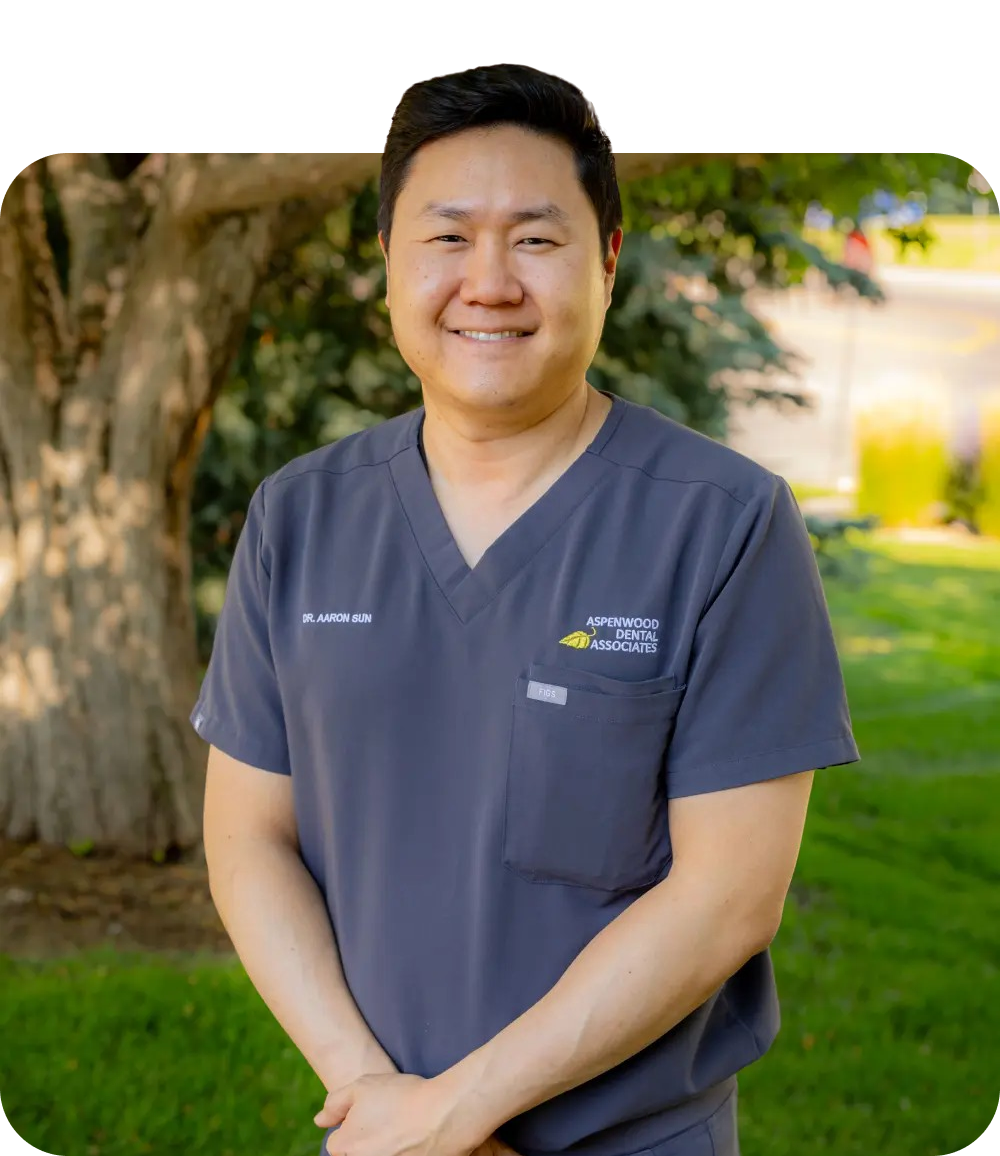
Meet Dr. Aaron Sun, DDS
Meet Dr. Aaron Sun, Aspenwood Dental Associates and Colorado Dental Implant Center’s Lead Dentist.
Dr. Aaron Sun earned his Doctor of Dental Surgery (DDS) from the University of Colorado and has built his practice philosophy around one principle: explain everything, rush nothing, and always put the patient’s long-term health first. He is particularly experienced in conservative restorative dentistry — the art of preserving natural tooth structure through precisely crafted inlays, onlays, and minimally invasive techniques. Aurora patients who’ve been told they need a crown frequently come to Dr. Sun for a second opinion and leave with a treatment plan that saves more of their natural tooth. His calm, educational approach — breaking down every option in plain English before any treatment begins — has earned Aspenwood a 4.9-star rating across more than 1,600 Google reviews.
Visit Aspenwood Dental Associates and Colorado Dental Implant Center in Aurora
Aspenwood Dental Associates and Colorado Dental Implant Center 2900 S Peoria St Ste C, Aurora, CO 80014, United States
We’re located at 2900 S Peoria St Ste C in Aurora — easily accessible from Heather Ridge, Seven Hills, Mission Viejo, Murphy Creek, and Tollgate Crossing. Patients from the Cherry Creek State Park corridor and the Colorado Freedom Memorial area frequently make us their dental home. Ample parking is available on-site.
Inlay vs. Onlay vs. Crown: What Aurora Patients Ask Most
What is the exact difference between a dental inlay and a dental onlay?
An inlay restores damage or decay confined to the area between the cusps — the “valleys” of your tooth — without touching the raised points. An onlay does everything an inlay does, but extends over one or more cusps when the damage is more widespread. Both preserve significantly more natural tooth structure than a full crown. At Aspenwood Dental Associates and Colorado Dental Implant Center, we determine which is appropriate based on a thorough clinical exam, not a one-size-fits-all protocol.
Is an onlay really a better choice than a full crown for Aurora patients?
For the right tooth, yes — and this is one of the most important questions you can ask. A crown requires removing a substantial portion of healthy enamel that can never grow back. If the damage to your tooth is limited enough that an onlay can restore full function and protect the remaining structure, preserving that enamel is almost always the better long-term decision. Colorado’s dry, high-altitude climate already puts stress on tooth enamel over time; removing healthy enamel unnecessarily only accelerates future vulnerability.
How much do porcelain inlays and onlays cost without insurance in Aurora, CO?
Porcelain inlays typically range from $650 to $1,200 per tooth, and onlays from $900 to $1,500 per tooth, depending on the size of the restoration and the material selected. While the upfront cost is higher than a large composite filling, the longevity of a well-placed porcelain onlay — often 15 to 30 years with proper care — makes it a sound long-term investment compared to repeatedly replacing a failing filling. We offer financial flexibility and full transparency, and our team will walk you through every cost and coverage detail before treatment begins.
Will my dental insurance cover an inlay or onlay at Aspenwood Dental?
Many dental insurance plans classify inlays and onlays as major restorative procedures, typically covering 50% after your deductible is met — though this varies significantly by plan. Our team will verify your benefits before your appointment and give you a clear, written estimate of your out-of-pocket responsibility. We believe in financial clarity without surprises. If you’re uninsured, ask us about our in-house membership plan, which provides immediate savings on restorative procedures without the delays of third-party insurance.
Does getting a dental inlay or onlay hurt? What should I expect during the procedure?
Most patients are surprised by how comfortable the process is. The area is numbed with local anesthetic before any preparation begins, and Dr. Aaron Sun’s team works at a pace that prioritizes your comfort throughout. If you have dental anxiety or a history of difficult experiences in the chair, we offer sedation options and will take as many breaks as you need. The second appointment — when your permanent restoration is bonded in — is typically brief and requires no anesthetic at all. If you’ve had a bad experience in the past, you’ll find a genuinely different environment here.
How long does a porcelain onlay last compared to a large composite filling?
A large composite filling in a high-stress area typically lasts 5 to 10 years before it begins to crack, shrink, or leak — and when it fails, it often takes more tooth structure with it. A well-bonded porcelain onlay, by contrast, routinely lasts 15 to 30 years and bonds to the remaining tooth structure in a way that actually reinforces it. For Aurora patients who want a long-term solution rather than a repeated cycle of repairs, the onlay is almost always the stronger investment.
Is this inlay or onlay service part of Aspenwood’s broader restorative care in Aurora?
Yes. Inlays and onlays are one part of a comprehensive restorative approach that includes dental crowns, composite fillings, and full mouth reconstruction — all available at our Aurora office. If your tooth has progressed beyond what an onlay can address, or if you have multiple teeth with failing restorations, our team can assess the full picture and map out a phased treatment plan that fits your timeline and budget. We’re not here for a single appointment; we’re here to be your dental home for life.