
Medically Reviewed by Dr. Aaron Sun, Implant Dentist at Aspenwood Dental Associates & Colorado Dental Implant Center — serving Aurora and the greater Denver area for over 50 years.
Key Takeaways
- The largest recent dataset, covering 45,715 bone grafts placed between 2014 and 2022, reported a clinical success rate of 97.83 percent for the augmented cohort.
- Most published bone graft success rates are really implant survival rates in grafted sites, which is a related but different measurement.
- Around 70 percent of failures occurred within the first year, and immediate implant placement carried a higher failure rate than delayed placement.
- No practice should quote you a local success rate without prospectively tracked outcomes, a stated definition of success and a stated follow-up period.
Published figures for dental bone grafting sit high, and the largest recent dataset reports a clinical success rate of 97.83 percent. That number needs three qualifications before it is useful to you. Most of what is written on this subject quotes a percentage with no source, no date and no definition of what was being measured.
The three qualifications are these. First, most published success rates for bone grafting are actually implant survival rates in grafted sites, which is a related but different measurement. Second, the figures come from other populations in other health systems, not from any individual practice. Third, success is defined differently between studies, so two papers reporting similar percentages may not be counting the same thing.
Aspenwood Dental Associates and Colorado Dental Implant Center have been an independent practice in Aurora since 1972. The research below carries its sources and dates so you can read it yourself, because a number without a citation is marketing rather than information.
What the largest recent study found
A retrospective analysis published in the Journal of Functional Biomaterials on 15 January 2026 examined 158,824 implants placed between 2014 and 2022 within a national healthcare network, of which 45,715 involved dental bone grafts. It is the largest real-world cohort published on this question.
- The augmented cohort showed a clinical success rate of 97.83 percent, a 2.17 percent failure rate, which the authors describe as statistically comparable to the general implant population.
- Failures were predominantly early. Roughly 70 percent of losses occurred within the first year.
- Immediate placement carried higher risk than delayed placement, at 3.08 percent failure against 2.07 percent.
- Male gender and maxillary location were also identified as independent risk factors.
- Lower socioeconomic status was a significant predictor, with a 3.07 percent failure rate against 2.06 percent in higher socioeconomic groups.
The authors’ conclusion is worth quoting in substance: simultaneous bone augmentation is a predictable modality that does not inherently increase implant failure risk, while failure is modulated by specific variables that warrant personalized risk assessment. The paper is open access and can be read in full at PMC.
Notice what that study measured. It counted implant failure in augmented sites. It is a strong answer to the question most patients are actually asking, which is whether grafting makes the implant less likely to work. It is not a direct measure of how often a graft itself achieves the bone volume intended.
Sinus augmentation, measured separately
The posterior upper jaw is the site most often needing augmentation, because the sinus tends to expand downward after upper back teeth are lost. It has its own literature.
A meta-analytic study of implant survival following sinus augmentation registered 3,975 implants placed in sinus augmentations using a lateral window approach, of which 3,749 survived, a survival rate of 94.3 percent. The same analysis concluded that bone substitute materials performed comparably to autologous bone whether used alone or in combination, that roughened implant surfaces performed better than smooth, and that placing implants at the same time as grafting rather than in a later stage carried a higher failure rate. It is available at PMC.
A 2022 systematic review and meta-analysis in the Journal of Indian Prosthodontic Society, covering seventeen studies, found no statistically significant difference in implant survival between direct and indirect sinus lift approaches, concluding that technique should be selected according to the indications for each. It is available at PMC.
Where the complications are
A success percentage tells you nothing about what happens in the minority of cases, and that is the part worth reading before consenting to anything.
A systematic review of intraoral onlay block bone grafts published in Medicina Oral Patologia Oral y Cirugia Bucal in 2015 found that survival and success rates of implants placed in horizontally and vertically resorbed ridges reconstructed with block grafts were similar to those of implants in native bone. It also catalogued the complications, which it reported as mainly mucosal dehiscence, exposure of the bone graft or membrane, complete failure of block grafts, and neurosensory alterations. It is available at PMC.
Reviews of ridge preservation and guided bone regeneration report post-operative pain, swelling, redness, soft tissue inflammation and infection as the common findings, with membrane exposure and the possible need for further surgical intervention noted as limitations of guided bone regeneration specifically.
None of that makes grafting a bad idea. It makes it a surgical procedure with a complication profile, which is what informed consent is for.
Why nobody should quote you a local success rate
You will find pages promising a success rate for bone grafting in a named city. Treat those with caution.
A meaningful practice-level figure would require prospectively tracked outcomes on a defined cohort, with a stated definition of success, a stated follow-up period, and enough cases for the number to mean anything. Very few general practices anywhere hold data of that quality, and a percentage produced without it is an estimate dressed up as a statistic. The published figures above are the honest basis for a conversation, and they come from large multi-site datasets in other health systems rather than from any one office in Colorado.
What a practice can legitimately tell you is what it does, how it assesses your particular site, what it would recommend, and what it would do if the graft did not achieve what was intended. Those are better questions than a percentage.
What actually affects the outcome in your case
The published risk factors and the clinical factors overlap. These are the ones worth discussing at a consultation.
- Smoking. Consistently associated with poorer healing in the surgical literature and one of the few variables entirely within a patient’s control.
- Diabetes and glycemic control, and other conditions affecting wound healing.
- Medications affecting bone metabolism, particularly antiresorptive therapy. This must be disclosed before any surgery involving bone.
- How much bone is missing and in which direction. Vertical deficiency is generally harder to correct predictably than horizontal.
- Whether the implant is placed at the same time as the graft or later. Both the 2026 dataset and the sinus meta-analysis found higher failure with simultaneous placement.
- Site infection at the time of grafting, which is why treating disease first matters.
- Following post-operative instructions, which sounds trivial and is not. Graft material is displaced by pressure and by early loading.
Questions to ask before you agree to a graft
- What exactly is deficient in my case, in which dimension, and how was that measured?
- What graft material is proposed, and why that one?
- Is the implant being placed at the same time or later, and what is the reasoning?
- What happens if the site does not develop as hoped? What is the fallback, and what does it cost?
- What are the specific risks in my case given my medical history and medications?
- How long is the healing period before the next stage, and what do I need to avoid during it?
- Is a referral to a specialist appropriate for a case like mine?
General information is not a diagnosis. Whether grafting is appropriate for you and which approach is better is a decision that requires an examination, three-dimensional imaging, and a review of your medical history.
How Aspenwood assesses a graft site in Aurora
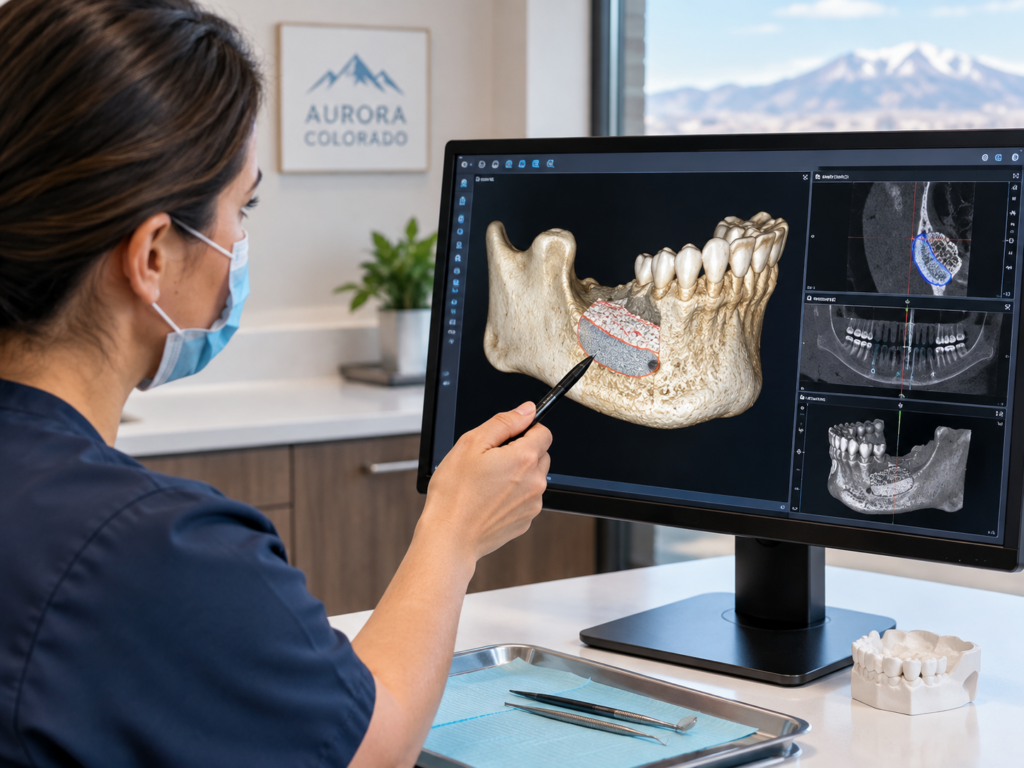
Published research describes populations. An assessment here starts with three-dimensional imaging of your jaw, a review of your medical history and medications, and a specific answer about what is deficient, in which dimension, and what would be needed to correct it.
We will also tell you what the fallback is if the site does not develop as hoped, before you consent rather than after, and whether a referral to a specialist is the better route for a case like yours. As an independent practice, we have no reason to keep a case we should hand on.
Frequently Asked Questions
What is the success rate of a dental bone graft?
Dental bone grafts have a high success rate, typically ranging between 90% and 98%, according to the Cleveland Clinic.
Success Rates by Graft Material
- Autografts (Your own bone): 95% to 98% success. This type uses bone taken from another part of your body and integrates best.
- Allografts and Xenografts (Donor or animal bone): 85% to 92% success. These use sterilized bone from a human donor or an animal source.
- Synthetic materials: 85% to 92% success. These use lab-made, biocompatible bone substitutes.
Is a graft success rate the same as an implant success rate?
No, a bone graft success rate is not the same as a dental implant success rate, as they are two distinct procedures that heal and integrate at different stages.
What is the success rate for a sinus lift?
The success rate for a sinus lift surgery generally ranges from 85% to 97%, with many clinical studies reporting long-term success and implant survival rates exceeding 95%.
What makes a bone graft more likely to fail?
A bone graft is more likely to fail when blood supply is poor, an infection develops, or the graft site experiences early movement.
What complications are reported with bone grafting?
Common complications reported with bone grafting include infection, graft failure, and nerve injury. According to medical overviews from sources like the Cleveland Clinic, while procedures are generally safe, various risks can occur depending on the graft’s location and type.
Should I trust a local success rate quoted by a dental practice?
You should treat a dental practice’s self-quoted success rate with cautious skepticism. While major dental procedures like implants do boast high baseline success rates globally (typically 90% to 98% under ideal conditions), localized metrics used in office marketing can be highly selective, misleading, or entirely untracked.
Get your own site assessed
Published research describes populations. It cannot tell you what is happening in your jaw. If grafting has been raised, book a complimentary consultation, and we will take the imaging, look at the specific deficiency, explain the options, including whether a referral is the better route, and set out the risks that apply to you. Reach us through the contact page or call (303) 529-2913.
Suggested previous post: How to Afford Full Mouth Restoration in Aurora
Suggested next post: When You Need More Bone: Dr. Sun’s Plain English Guide to Dental Bone Grafting
______________________________________________________________________________
Aspenwood Dental Associates and Colorado Dental Implant Center
2900 S Peoria St, Suite C, Aurora, CO 80014
Phone: (303) 529-2913
Monday 7:00 AM to 4:00 PM | Tuesday 10:00 AM to 6:00 PM | Wednesday 7:00 AM to 4:00 PM | Thursday 8:00 AM to 6:00 PM | Friday 7:00 AM to 2:00 PM | Closed Saturday and Sunday
Independent, family-owned dental care from one office on S Peoria Street since 1972.
 How to Afford Full Mouth Restoration in Aurora